Why every golf course should run a direct booking audit
Golfers are already searching for your course online, checking rates, tapping Book Online, and deciding how quickly they can reserve a round.
Many courses still do not control the full path from golfer intent to completed booking. A golfer may search for your course by name and end up on a third-party marketplace, land on your website and struggle to find the tee time button, or hit a mobile flow with too many screens, forced account creation, or slow-loading pages.
"A direct booking audit is not a technical exercise. It is an operator exercise."
GolfBack Team
The point is simple: check whether golfers can find you, book you, and stay connected to your course with as little friction as possible. GolfBack's position is that courses should own more of the booking path, the golfer relationship, the customer data, and the revenue opportunity instead of handing those pieces away by default.
What a direct booking audit actually checks
Key takeaway
The goal is not just to have online booking.
The goal is to make sure the booking path is direct, visible, mobile-friendly, easy to complete, and useful to your business after the round.
- When a golfer searches your course by name, where does the book online button send them?
- Is your website built to drive tee time bookings?
- Can a golfer book quickly on a mobile phone?
- Are you forcing unnecessary login steps?
- How many clicks does it take to reach available tee times?
- Who owns the golfer data after the booking?
- Is the booking experience helping your course build repeat play?
1. Search your course on Google
Start where golfers start. Search your course name and common variations like tee times, book online, golf course, and local city-based searches.
Operator checklist
Checks to run in Google
Confirm your Google Business Profile has the correct course name, address, phone number, website, hours, photos, and primary links.
Test whether a Book Online or tee time button appears and follow the path yourself.
Verify that branded course-name searches route golfers into a course-owned booking experience instead of a third-party marketplace.
Review what a golfer sees before they ever reach your website.
This is one of the most important checks in the audit. Golfers searching for your course by name are high-intent visitors. Ideally, that demand should connect directly to your booking path so the course keeps the booking, the customer relationship, and the data.
2. Review your website CTA placement
Open your website like a golfer would, on both desktop and mobile, and ask one question: can a golfer immediately see how to book a tee time?
- Main navigation
- Hero section near the top of the homepage
- Sticky mobile header or visible mobile menu
- Tee times or rates page
- Footer
- Relevant landing pages from search, email, or ads
Your booking CTA should not be buried in a dropdown or treated like a secondary task. Simple labels such as Book a Tee Time, View Tee Times, Reserve Your Round, or Book Online work better than vague calls to action when golfer intent is clearly to book.
3. Test the mobile booking flow
Most golfers are booking from a phone, often quickly and in the middle of something else. That means the mobile experience matters more than many operators think.
Operator checklist
Mobile friction to watch for
Slow page load times
A Book Tee Time button that is hard to find or tap
A booking engine that does not fit the screen well
Dates, times, rates, and player counts that are hard to select
Pop-ups blocking the flow
Being forced to login to view availability or checkout
A checkout experience that does not feel clear or trustworthy
A clunky mobile path usually does not produce complaints. It produces quiet drop-off. A useful standard is whether you would confidently ask a first-time golfer to book from your website on a phone in under one minute.
4. Count the clicks to available tee times
Key takeaway
Click depth is a conversion issue, not just a convenience issue.
A golfer with booking intent should not have to work hard to see real availability. Every extra step is another chance to leave before reaching your tee sheet.
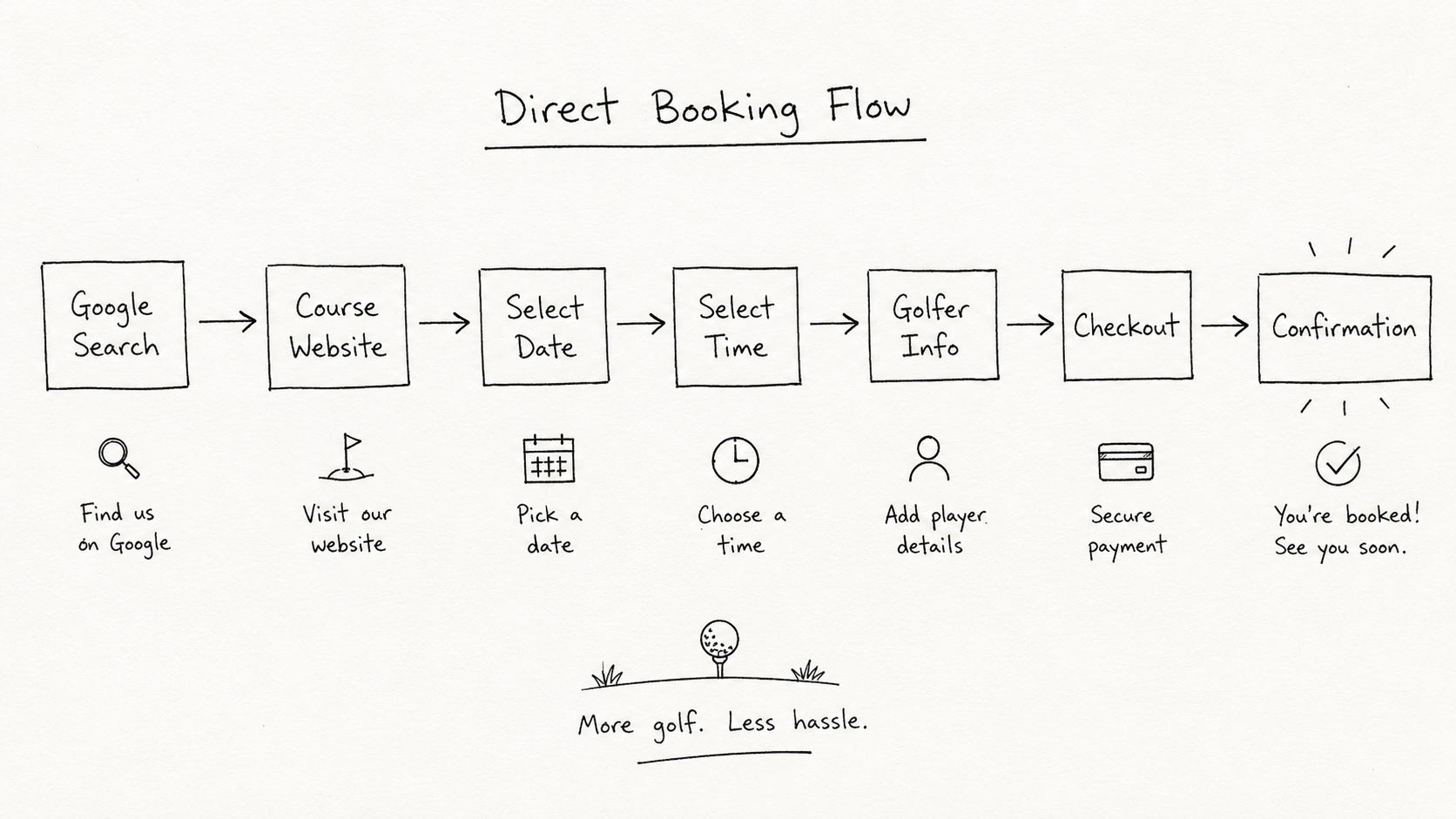
- Strong path: Homepage -> Book Tee Time -> Available tee times
- Weaker path: Homepage -> Golf -> Tee Times -> External provider -> Select course -> Select date -> Create account -> Available tee times
5. Look for forced login friction
Courses need golfer data, but forcing account creation too early can reduce conversion before the golfer even understands price or availability.
Operator checklist
Questions to ask about login requirements
Can golfers view available tee times before creating an account?
Is login required before they understand the price?
Can returning golfers move faster?
Is guest checkout available?
Is the account step clearly explained?
Does the flow collect useful data without making the golfer feel blocked?
The best booking experiences balance conversion and data capture. They make it easy to complete the reservation while still helping the course build a usable golfer database for repeat communication.
6. Check whether the booking path stays direct and supports data ownership
A direct booking path should feel like it belongs to your course, even when multiple technologies are involved.
Operator checklist
Red flags that the relationship is leaking away
The booking page heavily promotes a third-party marketplace.
Competing courses appear during the booking process.
Your course branding disappears.
The confirmation email does not clearly reinforce your course.
Golfer data is not easy for your team to use later.
Your team cannot communicate effectively with golfers after they book.
This is where many courses lose more than a single transaction. They lose the chance to build a repeat customer relationship. After a golfer books online, your course should still own the communication, the data, and the follow-up opportunity.
- Can your team easily see who booked and who played?
- Can you tell how often golfers return and which channels drive bookings?
- Can you identify which golfers respond to email, book prime times, or have not returned recently?
- Can you segment golfers for future campaigns?
7. Compare your direct rate strategy
Golfers need a reason to book direct. If outside channels show the same rate, a better rate, or a smoother experience, your course may be training golfers to shop somewhere else first.
Operator checklist
Direct rate strategy review
Is your best available rate protected on your direct channel?
Are website-only offers clearly promoted?
Do golfers understand why they should book direct?
Are third-party rates undercutting your own booking path?
Are soft-demand tee times promoted through your own website and email list first?
Are you using direct booking tools to create urgency for specific inventory?
This does not mean every course should abandon every outside channel. It means operators should understand the role each channel plays and avoid teaching golfers that the best path starts somewhere other than the course.
Use a simple scorecard, then fix the highest-friction gaps first
Operator checklist
Quick direct booking scorecard
Google Book Online path sends golfers to the right place
Website has a clear Book Tee Time CTA above the fold
Mobile booking flow is fast and easy
Available tee times are visible within two to three clicks
Login does not block the golfer too early
Booking path keeps the golfer in your brand experience
Confirmation and follow-up support your course relationship
Golfer data is usable for marketing and repeat play
Direct channel has a clear reason to book direct
Staff can explain where online bookings come from
- Fix the Google booking path if branded demand is being sent to the wrong place.
- Make the tee time CTA obvious on the website.
- Shorten the mobile path and remove unnecessary steps.
- Review login requirements so golfers are not blocked too early.
- Turn booking data into repeat-play campaigns and better follow-up.
Why this matters and how GolfBack helps
Golf courses are not just competing on course conditions, location, or price. They are competing on digital convenience.
When a golfer is ready to book, the course with the clearest path often wins. If your direct channel is hard to find, hard to use, or disconnected from your customer data, you may be losing revenue opportunity without seeing it clearly on the tee sheet.
Operator checklist
What a better direct booking path improves
Captures more high-intent demand
Keeps more golfers in your own channel
Builds a stronger customer database
Reduces reliance on third-party booking behavior
Improves repeat golfer communication
Creates a cleaner experience from search to tee sheet
Gives operators better visibility into online performance
Direct Booking Path
Own more of the path from search to tee sheet.
GolfBack helps courses improve Google visibility, website conversion, booking flow performance, golfer data capture, and repeat-play follow-up through channels the course controls.
Talk to GolfBack